
Academic Career Coach: What They Do and How to Choose
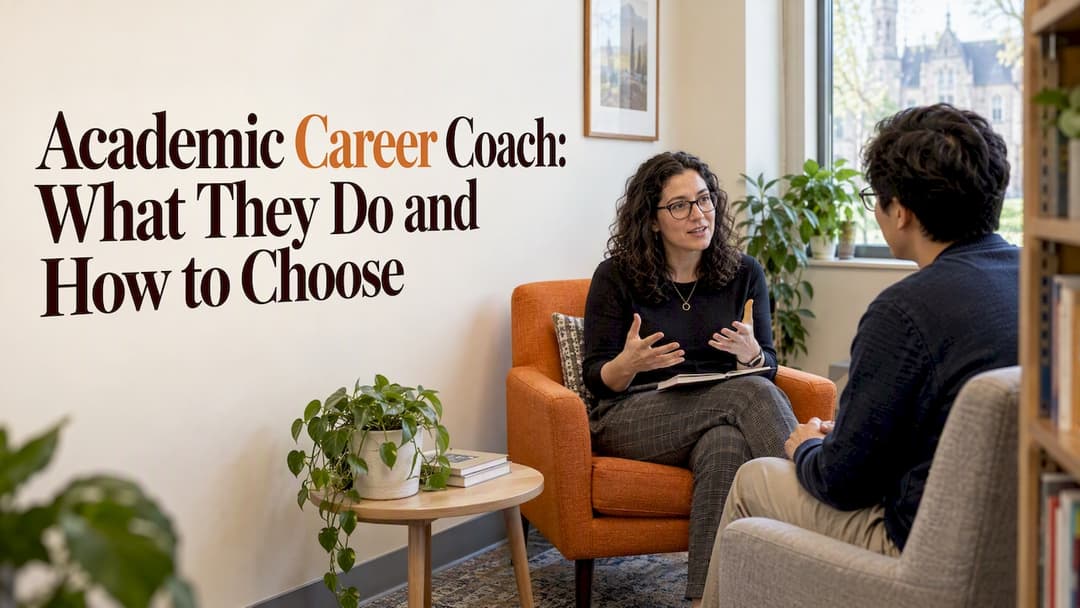
An academic career coach is a one-to-one thought partner who helps you decide where your career in or around higher education should go, then helps you build the materials, contacts and habits to get there. The best ones don’t hand you a destination. They ask questions until your own answer gets clear, and then they hold you to it.
This guide covers who benefits, what a coach actually does week to week, how coaching works for academics weighing a move outside the university (including engineers, data scientists and analysts), what to expect on cost, and how to tell whether a coach is a good fit.
TL;DR
- An academic career coach helps you clarify goals, compare academic and nonacademic paths, prepare applications and interviews, and stay accountable.
- Coaching is for PhD students, postdocs, faculty and technical professionals at a decision point, not only for people who have already decided to leave.
- Good coaching is collaborative: you leave each session with two or three concrete action items.
- Before you hire anyone, write down your goal, the outcome you want, your available time and your spending limit.
- Coaching is not therapy or medical care. If you are in distress, see a licensed professional.
Table of Contents
- What an academic career coach does
- Who benefits from career coaching for academics
- Coaching for the academic job search
- Exploring paths inside or outside higher education
- Engineering, data science and data analyst career coaching
- What happens in a coaching session
- What it costs, and what moves the price
- How to choose a coach who fits
- Our perspective
- Working with Corgi Coaching
- FAQ
- Sources
What an academic career coach does
Stanford’s career education office describes a coach as a thought partner rather than a resume reviewer or a director: open-ended questions help you uncover your own answers and define your goals. That is a useful test for any coach you meet. If they start by telling you what to do, they are acting as a consultant, not a coach.
In practice, the work covers a predictable set of tasks:
- Reflecting on goals, values, interests and skills.
- Exploring career paths and making decisions between them.
- Preparing applications, statements and interviews.
- Networking and navigating transitions.
Ohio State’s guide to working with a coach frames it as a reflective process: you examine current skills and strengths, consider options, and build an individualized action plan that bridges where you are and where you want to be.
That last piece matters. Many academics are very good at analysis and much less practiced at turning analysis into a plan with dates and next steps. A coach supplies the structure and the accountability.
Who benefits from career coaching for academics
Coaching is not reserved for people who have already decided to leave. Stanford says its coaching serves undergraduates, master’s students, PhDs, postdocs and recent alumni. The University of Utah’s academic-coaching network lists programs for early-, mid- and advanced-career faculty covering academic success, professional growth, career reinvention, leadership and career transitions.
Here are the situations where we see coaching help most:
- Graduate students and postdocs unsure whether to pursue a faculty job, an industry role, or something else entirely. Inside Higher Ed notes that PhD students and postdocs commonly seek coaching for career clarity and professional purpose.
- Early-career faculty juggling research, teaching and service who need priorities and boundaries.
- Mid-career faculty and administrators who feel stalled, are considering leadership, or want a different kind of work.
- Academics leaving the academy who need to translate a CV into a resume and find roles they did not know existed.
- Technical professionals, such as engineers, data scientists and analysts, who want a clearer next move.
Coaching for the academic job search
If you are staying in higher education, the support is specific. Princeton’s graduate career guidance lists deciding about postdocs, academic applications, statements, interviews and offer negotiation as academic-track support.
A coach can help you with:
- Deciding between options. Postdoc or not? Which kind of institution fits your life and your work?
- Application materials. Tailoring a research statement, teaching statement or cover letter to a specific audience instead of sending one document everywhere.
- Interview preparation. Practicing the job talk, the one-on-one meetings and the questions about fit that candidates often fumble.
- Negotiation. Knowing what to ask for and rehearsing how to ask.
- Sustaining momentum. A search runs for months. Weekly check-ins keep it from stalling.
An important caveat: a coach does not know your field’s hiring committees the way your advisor or a senior colleague does. Use a coach for the process, the clarity and the accountability, and keep your disciplinary mentors for field-specific judgment.
Exploring paths inside or outside higher education
This is where coaching often earns its keep. Princeton’s perspective is that graduate training does not prescribe one destination: the goal is to determine what you want, academic or nonacademic, rather than follow outside pressure. Its nonacademic support starts by matching paths to interests, skills, values and personal or family circumstances.
Inside Higher Ed describes a process most good coaches follow in some form: assess skills, interests and values, interpret the results, filter possible academic and nonacademic paths, and then test options through informational interviews, networking and hands-on exploration. Only after that do you tailor applications, rehearse interviews and practice negotiation, with a roadmap you are accountable for.
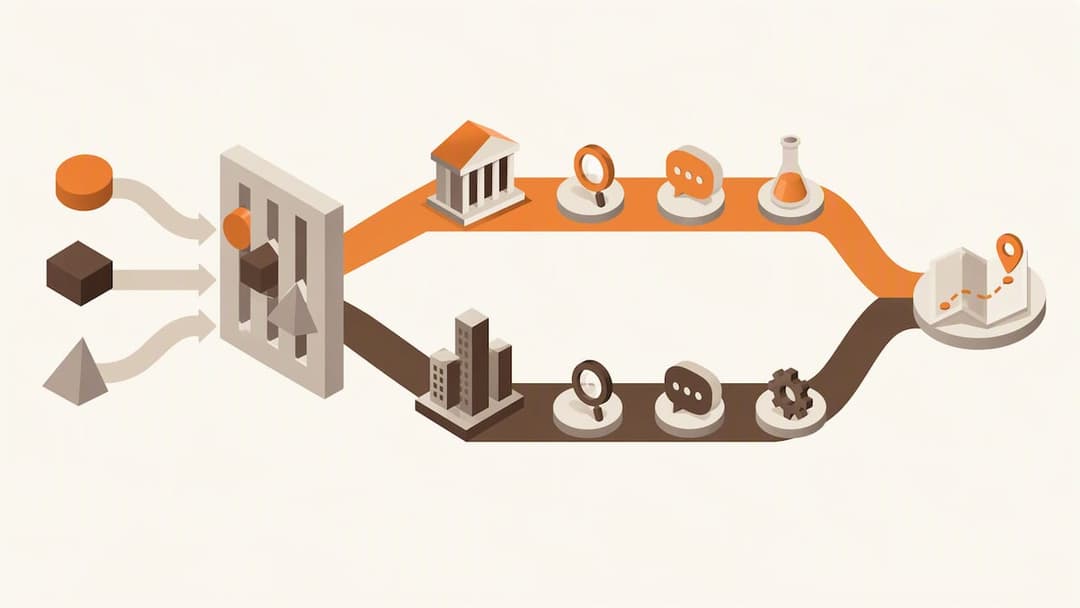
The same piece notes that coaches can act as connectors, helping you ask for introductions to people working in the fields and jobs you are considering.
A realistic example: a fourth-year postdoc in biology is interested in both a teaching-focused faculty role and a data-heavy job at a company. A coach would not pick one. They would help her list what she values (autonomy, mentoring, pace, location), set up three or four informational conversations with people in each path, and review what she learned after each one. By the end, one option usually feels clearly lighter or heavier than the other, and she has a reason that is hers.
We cover the broader mechanics of moving between fields in our guide to career transition coaching.
Engineering, data science and data analyst career coaching
People searching for an engineering career coach or a data science career coach often have a different problem from a humanities PhD: they have marketable skills and too many directions, or they cannot show their skills clearly on paper.
Ohio State says coaches can refine resumes, cover letters, portfolios, reference lists, and LinkedIn and Handshake profiles, and help you articulate your skills in applications and interviews. For engineers and analysts, that articulation is often the gap. Describing a project in terms of the decision it supported or the problem it solved reads differently from listing the tools you used.
The University of Texas computer science department’s planning guide lists data science among STEM career paths and says consultations can identify viable options and transferable skills, convert a CV to a resume, review application materials, prepare for interviews, network, evaluate offers and negotiate salary.
So what might that look like for you?
| If you are… | A coach can help you… |
|---|---|
| An engineer weighing a move from hands-on work to management | Clarify whether you want to lead people or stay technical, then plan the step |
| A data analyst who wants to grow into data science | Map transferable skills, decide what to learn first, and tell that story in interviews |
| A PhD leaving academia for industry | Convert a CV into a resume, frame research as results, and target roles |
| A data scientist with an offer in hand | Evaluate it against your goals and practice the salary conversation |
A coach will not teach you to code or review your technical work. The value is in direction, positioning and follow-through. Pair coaching with technical learning, not instead of it.
What happens in a coaching session
Washington University in St. Louis describes coaching as collaborative and individually tailored: the coach asks questions, brainstorms possibilities, shares tools and career information, gives feedback, and helps you leave with two or three action items. You do the reflecting, experimenting and choosing.
The University of Michigan’s computer science engineering program defines coaching as facilitating learning, development, well-being and performance, where clients identify goals, build their own strategies, develop skills, and change attitudes or behaviors. Its individual coaching for PhD students focuses on a chosen topic, strategy and accountability.
A typical early session goes like this:
- You describe where you are and what is not working.
- The coach asks questions that sharpen the goal.
- You agree on two or three actions before the next meeting.
- Between sessions, you do the work and report back.
The weekly rhythm is the point. A single consultation can give you a good idea. A weekly relationship gives you momentum on a search or a decision.
What it costs, and what moves the price
Coaching fees vary widely, and we are not going to give you a generic average that may not match your situation. These are the factors that drive the price:
- Format. A single consult, a package of sessions, or an ongoing subscription are priced very differently.
- Frequency. Weekly sessions cost more over a month than occasional ones, but they also move things faster.
- Coach background. Certifications and years of experience in a specific field tend to raise the fee.
- What is included. Messaging between sessions, document review and resources may or may not be part of the price.
UCSF’s guide to choosing a career development professional recommends that you define your goals, desired outcomes, available time and spending limit first, so you can judge whether a service matches what you need. We agree. Decide your limit before you start comparing, and ask every provider what is included.
If you are a student or postdoc, check first what your institution offers. Many university career offices provide coaching at no charge to current students and, often, recent alumni.
How to choose a coach who fits
Use these criteria to compare.
- A clear goal. If you can say “I want to decide between a faculty job and industry by spring” or “I want an analyst role in healthcare,” you can judge a coach against it.
- Relevant experience. Look for someone who has worked with people at your stage and understands your field or the field you want.
- Their method. Do they ask questions and build on your answers, or issue instructions? Stanford and Washington University both describe the client as the one who reflects and decides. That is the model to look for.
- Concrete follow-through. Ask how sessions end. Action items and a way to check in between meetings are good signs.
- Flexibility. Can you change coaches if the match is wrong? Can you stop when you have what you need?
- Honest scope. Coaching is not therapy. A good coach tells you when something needs a counselor or doctor.
Our perspective
Most academics who contact a coach already know a lot. They have read the advice, talked to colleagues and made lists. What is missing is usually not information. It is a regular, private place to think out loud with someone experienced, who then expects to hear what you did about it.
That is why we built our service around three things. A matching specialist reads your answers and picks a coach for your goals, so you do not have to sort through profiles yourself. You meet that coach by video once a week and can message between sessions. And if the fit is wrong, you can change coaches at any time at no extra cost, or cancel online whenever you want.
Our coaches average 10+ years of industry experience. We are straightforward about the limit: coaching supports decisions and action, and it does not replace therapy, medical care or crisis care.
— Sameer
Working with Corgi Coaching
If you want a weekly one-to-one partner for a decision about your career, our career coaching pairs you with a coach matched to your industry, role, stage and preferences. If you are in the middle of applications, job search coaching focuses on materials, interviews and offers. If the question is bigger than a job, life coaching is built for it.
You answer a few questions about where you are and what you want to change. Our matching specialist reads them and chooses your coach. You can see how it works or meet our coaches before you start.
FAQ
What does an academic career coach do?
An academic career coach helps you reflect on your goals, values and skills, explore paths inside and outside higher education, and prepare applications and interviews. They also keep you accountable to a plan. Sessions are collaborative: you leave with a few action items to complete before the next meeting.
Is it worth paying for a career coach?
It depends on what you need and what you can already get for free. If you are a current student or recent graduate, start with your institution’s career office. If you want steady, private, weekly support during a transition or search, a paid coach can give you structure and accountability that occasional advising does not. Set your goal and spending limit first, as UCSF advises.
Can a career coach help me leave academia?
Yes. A coach can help you assess your skills and interests, test nonacademic options through informational interviews, convert a CV to a resume, and prepare for interviews and negotiation. They cannot promise a job, but they can make your search more focused and consistent.
Can an engineer or data analyst use a career coach?
Yes. Coaches can help you choose between technical and management tracks, present your skills clearly in a resume and LinkedIn profile, and prepare for interviews and offers. They do not teach technical skills, so pair coaching with the learning your target role requires.
Sources
- Coaching | Stanford Career Education
- What Should I Expect From a Career Coach? | Ohio State
- The benefits career coaches can provide Ph.D.s and postdocs | Inside Higher Ed
- Pam Krieger | Princeton Center for Career Development
- Programs | Utah Coaching & Advancement Network
- Career Planning with IDP | University of Texas
- Frequently Asked Questions | Washington University Center for Career Engagement
- Professional Coaching for PhD Students | University of Michigan CSE
- FAQs: Choosing a Career Development Professional | UCSF