
Career Transition Coaching: How It Works and How to Choose

Career transition coaching is one-on-one work with a trained professional who helps you decide what you want next, build a realistic plan to get there, and keep moving while you do it. A good coach doesn’t pick a new career for you. They help you test options, use the experience you already have, and take steady steps instead of a risky leap. This guide explains what happens in coaching, how to plan a change, how to tell a coach from a therapist if burnout is part of the picture, and what to check before you hire anyone.
TL;DR
-
A career transition coach helps you clarify direction, translate your experience into a new field, and turn a vague wish into a weekly action plan.
-
Planning a change follows a pattern: self-assessment, occupational research, conversations with people in the field, a specific plan, and a reality check.
-
Coaching is client-driven. You do the work between sessions, so the support you get between calls matters as much as the calls themselves.
-
If burnout is severe, a licensed mental health professional is the right first call. A coach can work alongside that care or after it.
-
Before hiring, interview several coaches, ask for references, and check credentials, specialty and fit.
Table of Contents
What a career transition coach does
The National Career Development Association describes career professionals as people who help you understand yourself and carry out career decisions and plans, including transitions. Depending on the provider, services can include assessments, career planning, job search strategy, resume and LinkedIn help, networking, interview technique, salary negotiation, and support after a job loss.
In practice, a transition coach usually does four things:
-
Clarifies the question. Many people arrive saying they want out, without knowing what they want in. Early sessions turn “I hate this” into a short list of values, interests and conditions a next role must meet.
-
Reframes what you already have. Ten years in operations, teaching or nursing contains skills that transfer. A coach helps you name them in the language of the new field.
-
Builds the plan. That means specific goals, a timeline, and the next three actions, not a general intention.
-
Keeps you accountable. The plan only works if you act on it. Coaching creates a rhythm of commitment and review.
CNBC Make It’s guide to successful career changes lists similar benefits: working out whether a change is right, identifying a career, reframing current experience, overcoming impostor syndrome and developing a strategic roadmap.
Coaching, counseling, mentoring and therapy are different things
The University of Arkansas for Medical Sciences, in its coaching orientation, separates coaching from mentoring, sponsoring and therapy. Coaching uses active listening, reflective techniques and questions to build self-awareness, while the client decides what to change and stays accountable for results.
That has a practical meaning. A mentor tells you how they did it. A therapist treats mental health conditions. A coach asks questions, offers structure and challenges your assumptions, and you own the decisions.
Signs you may be ready for a coach
Coaching tends to help most when one or more of these sound familiar:
-
You know something has to change but can’t name the destination.
-
You have several ideas and no way to compare them.
-
You’ve started updating your resume three times and stopped three times.
-
You doubt that your experience counts in a new field.
-
A big change, such as a layoff, a move, a promotion you don’t want or a milestone birthday, has left you overwhelmed.
-
You work best with a regular check-in and someone expecting results.
If you want to think it through alone first, that’s reasonable. Harvard Extension School’s tips for changing careers recommend self-assessment, researching occupations, talking with people who do the work, and speaking with a career counselor to explore options. A coach compresses and structures that same process.
How to plan a career transition, step by step
Whether you work with a coach or not, the sequence below follows the steps Harvard Extension School outlines: self-assessment, researching occupations, speaking with people in the work, building an action plan, creating connections and experience, and a reality check.
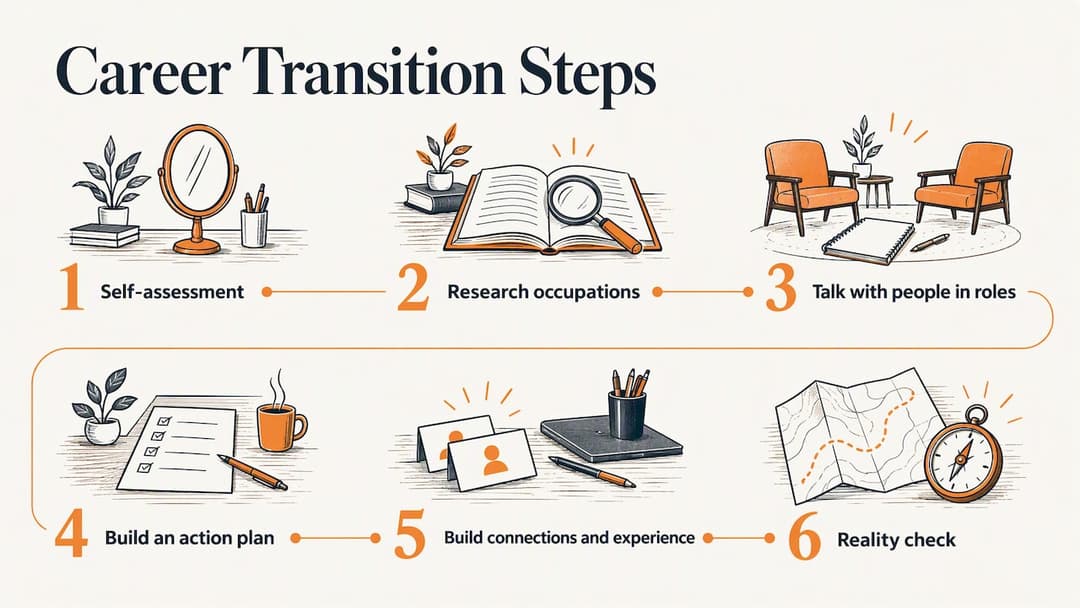
Step 1: Take stock of yourself
Write down what energizes you, what drains you, which skills you want to keep using, and which you’re happy to retire. Include values: income floor, autonomy, flexibility, mission, team culture. Stanford Graduate School of Business advises an honest self-inventory before a shift, and watching for early signs that work is taking a psychological toll.
Assessments can help too. NCDA notes that career professionals may use assessments of interests, values, abilities, skills and personality to build self-knowledge and identify options, then develop individualized short- and long-term plans with you.
Step 2: Research the occupations on your shortlist
Don’t commit on the strength of a job title. Look at what the work involves day to day, what training it requires, and how people move into it. The U.S. Bureau of Labor Statistics’ Occupational Outlook Handbook covers related-occupation work experience, on-the-job training, advancement requirements and pathways into other occupations, all useful for judging whether a move is realistic.
Step 3: Talk to people doing the work
Two or three conversations will teach you more than twenty articles. Ask what a normal week looks like, what surprised them, what they’d do differently, and how they got in. Coaches often help you find these people and word the first message.
Step 4: Write a specific plan
A plan has a target (a role type or two), a timeline, and weekly actions. For example: “Within eight weeks, hold five informational conversations, finish one short course and rewrite my resume around project management.” Vague plans stall; dated ones don’t.
Step 5: Build a bridge
Most successful changes aren’t jumps. They’re bridges: a volunteer project, a part-time engagement, an internal move, a freelance gig or a side project that gives you evidence in the new field. Harvard Extension School suggests building connections and experience through internships, volunteering, part-time work or extra projects.
Step 6: Run a reality check
Before you resign or sign up for an expensive program, test the numbers and the logistics. Can you cover your expenses during a pay dip? What does the typical entry route require? Who will vouch for you? A coach is useful here because they’ll ask the uncomfortable question while you still have time to adjust.
What the coaching process looks like
Georgia Tech’s professional education coaching FAQ describes a pattern that matches how most good coaching runs. You and your coach agree on overall goals. Each session then sets smaller goals, generates options, identifies strengths and obstacles, selects actions and sets a timeline. The coach manages the process, and you create and carry out the plan.
Between sessions, you complete the agreed actions and reflect on progress, accomplishments, difficulties and lessons. The next session starts from that review, so priorities can shift and accountability stays real.
UAMS adds two practical points: bring an agenda or goal to each call, and expect confidentiality, with any limited reporting set by the coaching arrangement.
Why support between sessions matters
Most of a career change happens outside the session: the networking message you send on Tuesday, the portfolio piece you finish on Saturday, the conversation you were dreading. If a coach is reachable only once every two or three weeks, momentum fades and doubts return. Ongoing contact in between turns a good conversation into steady progress. That’s the principle behind how we built our own service, described below.
Career coaching when you’re burned out
Burnout changes the question. Sometimes the job is the problem and a new role will help. Sometimes exhaustion is distorting your judgment, and any decision made now will be a decision made from depletion.
Three points will help you sort this out.
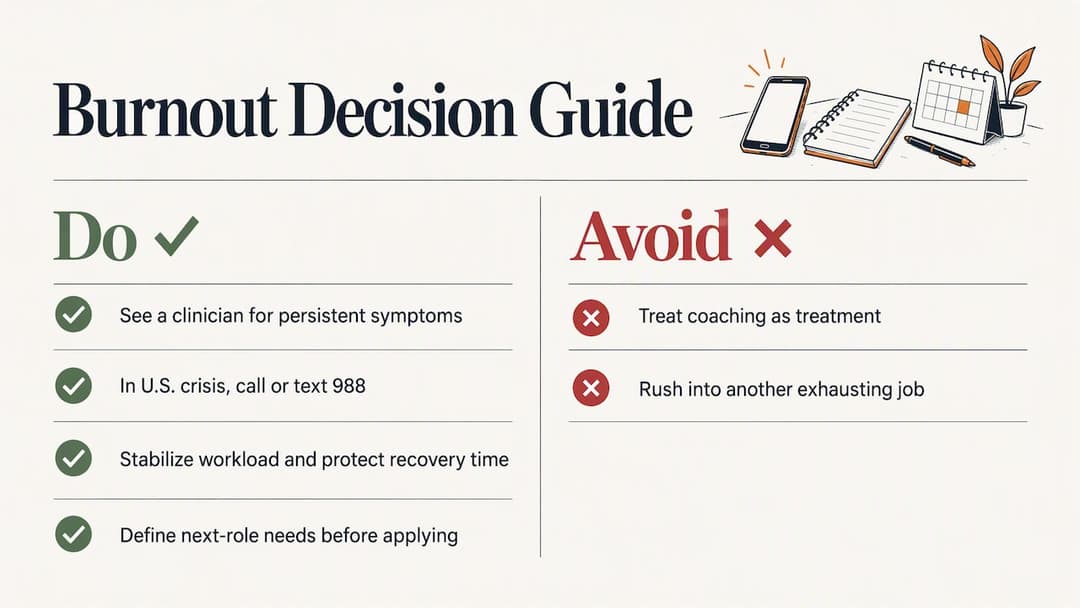
Coaching is not treatment. UAMS draws a clear line between coaching and therapy. If you have persistent low mood, anxiety, trouble sleeping or functioning, or thoughts of harming yourself, see a licensed mental health professional or your doctor first. In the U.S., you can call or text 988, the Suicide and Crisis Lifeline, at any time if you’re in crisis.
Support can be layered. The American Psychological Association’s interview with psychologist Craig Rooney says burnout support should be multi-pronged, combining individual mental health care with organizational or structural changes. He also notes that regular check-ins can catch problems before they become major and keep people from feeling isolated. That’s relevant to a job change: sometimes the structural change you need is a different employer, role or workload, which is where a coach comes in.
Sequence matters. If you’re depleted, a coach can start small: stabilize your workload, protect time to recover, and define what you’d need from the next role, before you begin applying. Rushing from one exhausting job into another is a common pattern, and a coach who asks about your conditions, not just your title, helps you avoid it.
If you want a single test: when the main question is “what should I do next?”, coaching fits. When the main question is “why can’t I function?”, start with a clinician, and bring a coach in when you’re ready to plan.
Working through the fear of changing careers
Fear is the most common reason people stay. It usually takes one of four forms:
| Fear | What it sounds like | What helps |
|---|---|---|
| Starting over | “I’ll be a beginner at 40.” | Map transferable skills and look for roles that value your past, not entry-level ones |
| Money | “I can’t afford a pay cut.” | Build a budget and a bridge, such as part-time work or a staged move, before you leave |
| Competence | “They’ll see I don’t belong.” | Gather evidence through small projects and conversations; treat impostor feelings as data, not verdicts |
| Regret | “What if I’m wrong?” | Run small experiments first, so the decision is informed rather than a leap |
CNBC Make It lists overcoming impostor syndrome among the things coaching can address. The aim isn’t to remove fear. It’s to make it smaller than the cost of staying stuck.
How to choose a career transition coach
The coaching field is largely unregulated, so the burden of vetting falls on you. The International Coaching Federation (ICF) has guidance on finding the right coach. It suggests assessing coaching education and credentials, experience, specialty, client types, philosophy, references and ethical affiliation. It recommends interviewing three coaches and requesting at least two references.
The same guide cites the ICF’s 2022 Global Consumer Awareness Study: 55% of respondents whose coach held a credential or certification said they were very satisfied, compared with 27% whose coach didn’t. The ICF also says its members and credentialed coaches commit to a Code of Ethics, and its directory lets you search by specialty, location and experience.
Use this checklist when you talk to candidates:
-
Relevant experience. Has the coach worked in or around your industry, role and career stage? Someone who has hired, managed or changed careers themselves can give more concrete advice.
-
Credentials. Which certification do they hold, and from whom?
-
Method. Do they offer structure and homework, or just conversation? Which do you want?
-
Cadence. How often will you meet, and how can you reach them between meetings?
-
Results and references. What happens for typical clients, and who can speak to it?
-
Terms. What does it cost, how do you cancel, and what if the fit is wrong?
Indeed’s guide to finding a career change coach adds a practical first step: write down your needs, goals and preferred working style before you start looking, so you can judge candidates against something concrete. NCDA also notes that services differ by provider training, competence and setting, and that techniques should be tailored to your needs and cultural considerations. Fit is not a soft factor. It decides whether you’ll show up and do the work.
Types of help to compare
Without naming anyone, the options you’ll meet fall into a few types:
| Type | Best for | Watch for |
|---|---|---|
| Independent career coach | Personalized direction and accountability | Wide variation in training and approach |
| Resume or job search specialist | Application materials and interview skills | Less help with deciding what to do |
| Career counselor (often licensed) | Assessments and deeper exploration | Session cadence and depth vary |
| Therapist or psychologist | Burnout, anxiety or mood concerns | Not designed to run your job search |
| Self-guided courses and books | Budget-conscious, self-directed people | No accountability; easy to stall |
Our perspective on career transition coaching
We built Corgi Coaching around a pattern we kept seeing: people don’t fail at career change because they lack ideas. They fail because direction is fuzzy, confidence dips, and the whole thing feels too big to start. A single conversation doesn’t solve that. Weekly momentum does.
That’s why we put two things at the center. First, matching. A matching specialist pairs you with a coach who fits your goals, your industry and role, your career stage and your preferences, because the best coach for a nurse moving into health tech isn’t the best coach for a finance director rethinking everything. Our coaches average 10+ years of industry experience.
Second, continuity. You get a private weekly video session, and you can message your coach between sessions. When something comes up on Wednesday, such as a recruiter email, a wobble about a resignation letter or a draft you want eyes on, you don’t wait two weeks. Small weekly steps compound.
We also think you should be free to leave. You can switch coaches or cancel your plan online at any time, because a coaching relationship that isn’t working should be easy to change.
Our honest view of limits: we’re a coaching service, not a mental health provider. If burnout has tipped into something clinical, get that care first. We’ll be here when you’re ready to plan what comes next.
How Corgi Coaching can help with your transition
If you want a coach matched to your situation, our career coaching pairs you with a trained coach for weekly private video sessions plus messaging in between. If your move is mainly about landing the next role, job search coaching is built for that. If the question is bigger than work, life coaching covers the wider picture. Both start with a discounted trial week. You can see the steps on our how it works page, or meet our coaches before you decide.
What to bring to your first session
You’ll get more from the first weeks if you arrive prepared. Bring:
-
A one-paragraph summary of why you want to change now.
-
A list of the best and worst parts of your current and past roles.
-
Two or three career ideas, even half-formed ones.
-
Practical constraints: income needs, location, family commitments, timeline.
-
A first small question to test, such as “What would it take to move from teaching into instructional design?”
Treat the coach as a thinking partner and the plan as yours. As UAMS puts it, clients are responsible for their results, and the clients who make progress tend to show up with an agenda and finish what they agreed to do.
FAQ
How is career transition coaching different from career change coaching?
In everyday use, the terms overlap. Career change usually means moving to a different field or role type, while transition can also cover a layoff, a return to work, a promotion into management or a step toward retirement. Check a coach’s experience against your specific situation rather than the label.
How long does it take to change careers with a coach?
It depends on the distance between where you are and where you want to be, and on how much time you can put in each week. A move within your industry can take weeks to a few months, while a move into a new field often takes longer because it involves building experience and relationships. A coach can help you set a realistic timeline in the first sessions instead of promising a date.
Can a career coach help if I’m burned out?
Yes, for the career part: working out what conditions you need, what to leave behind and how to pace a move. A coach doesn’t treat burnout. If you’re struggling to sleep, function or cope, or you feel hopeless, talk to a licensed mental health professional or your doctor first, and consider coaching alongside or after that care.
How do I know if a coach is qualified?
Ask about certification, years of relevant experience, specialty and ethical commitments. The ICF suggests interviewing three coaches and asking for at least two references. Then notice how the conversation feels: you should leave a first call clearer, not pressured.
What if the coach isn’t a good fit?
Say so early and ask for a change. With us, you can switch coaches or cancel your plan online at any time, so a poor match doesn’t have to cost you months.
Sources
-
How and When to Shift Careers | Stanford Graduate School of Business
-
Occupational Information Included in the OOH | U.S. Bureau of Labor Statistics