
Boredom at Work: Why It Happens and What to Do About It

Boredom at work is common, and it is usually a signal, not a character flaw. A slow afternoon is normal. Feeling bored most days means something about your tasks, your role or your growth needs to change. This guide covers what causes boredom, what to do today when you have nothing left to do, how to fix the underlying problem, and how to tell when it is time to look at a different role.
TL;DR
-
Occasional boredom is normal. Boredom that shows up most days is worth acting on, because it is linked to stress, fatigue and disengagement.
-
The usual causes are work that is too easy (or too hard), little autonomy, little meaning, and red tape. Each calls for a different fix.
-
For a slow day, use the time to learn, tidy up, connect with colleagues or find work with real impact. Then talk to your manager about the pattern.
-
If you have tried to reshape the job and nothing changes, boredom can be a sign to consider a different role, company or direction.
Table of Contents
Is it normal to be bored at work?
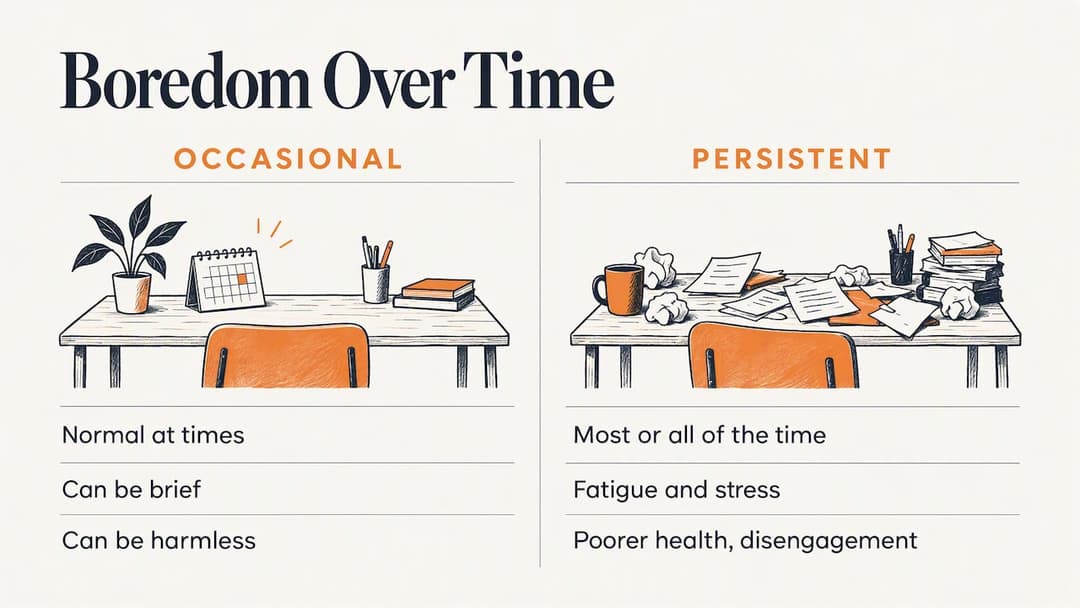
Yes. Experts from the American Psychological Association say that occasional boredom at work is normal, while feeling bored most or all of the time is a different situation. In that discussion, persistent boredom is tied to fatigue, stress, poorer self-rated health and disengagement.
Researchers define workplace boredom as an unpleasant, passive state: low interest, and trouble keeping your attention on work that does not stimulate you enough. The same research notes that boredom can be brief and harmless, but it can recur and settle in when you keep meeting the conditions that cause it.
That is the line to watch. One dull Tuesday is a Tuesday. Dull most weeks for months is a pattern.
When boredom stops being harmless
The evidence on persistent boredom is not reassuring:
-
A 2024 study in Industrial Health links persistent boredom to dissatisfaction, weaker commitment to the organization, greater willingness to leave, psychological distress, sickness absence and withdrawal.
-
A survey of 189 employees found that work boredom was associated with bored behavior, which in turn was linked to depressive complaints, distress and counterproductive work behavior.
-
A 2025 study in Current Psychology found that daily job boredom was positively related to burnout on a day-to-day basis, though not to intentions to quit.
-
A review of the healthcare workplace reports that boredom can bring distraction, stress, disillusionment, lower engagement, errors and lower productivity.
None of this means a bored week will damage your health. It means that chronic boredom deserves the same attention you would give to chronic overwork.
Boreout versus burnout
You have probably heard of burnout. Boreout is its mirror image. In the APA discussion, burnout is generally linked to too much work and overwhelming demands, while boreout involves too little challenging, interesting or meaningful work.
They can overlap, too. Some people are bored by the content of their work and exhausted by the pointless parts around it, such as approvals, status meetings and paperwork. If that sounds like you, you are not imagining it.
What causes boredom at work?
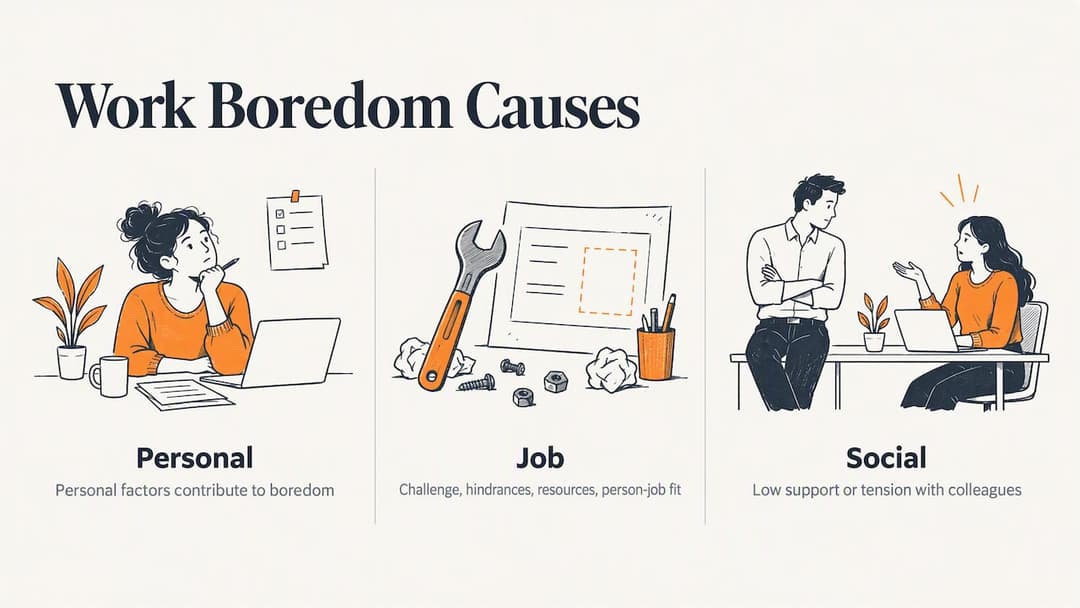
Boredom is rarely about laziness. A systematic review of the causes groups them into three families: personal factors, job factors (too little challenge, too many hindrances, too few resources, poor person-job fit) and social factors such as low support or high tension with colleagues. Because the causes are mixed, one remedy will not fit everyone.
Here are the patterns that show up most often.
Work that is too easy, or too repetitive
Monotonous tasks and mental underload are classic triggers. The research also points out that tasks can be boring when they are under-challenging or over-challenging relative to your abilities. If you freeze up and tune out because work is too hard, that can look like boredom from the outside.
Little autonomy
The same research identifies feeling trapped, with little say in how you work, as one of four broad contributors, along with a challenge level that is too low or too high, low meaning, and difficulty sustaining attention. If every step of your day is prescribed, your brain has nothing to decide, and nothing to care about.
Red tape and poor use of your skills
The 2024 Industrial Health study found that red tape was positively related to boredom. Poor use of skills, standardization and a lack of meaning were also on the list of job resources that were missing. Notably, the link between workload and boredom depends on the kind of demand: pointless demands feed boredom, while stimulating ones do not.
Automation and passive monitoring
A peer-reviewed review warns that automation can increase monotonous monitoring work, which is hard on attention. If your job has shifted from doing to watching, that may be why your days feel flat.
A signal about what you need
Boredom often points to an unmet need. Indeed notes that boredom during the workday and a lower desire to innovate can indicate underused skills. Ask what is missing: growth, variety, recognition, purpose, people. The answer decides your next move.
Bored at work with nothing to do: what to try today
If you have finished your tasks and the clock is crawling, you have a short-term problem and a long-term one. Start with the short-term one, and use the time well.
Quick moves for a slow day
-
Ask for more work, or different work. Look for responsibilities that line up with your department or company goals. Indeed suggests taking on tasks outside your usual purview when you have capacity.
-
Learn something small and useful. Oregon State University’s Ecampus Career Hub suggests learning a keyboard shortcut or trying an AI tool to speed up routine work.
-
Write down your recent wins. The same list recommends keeping a record of recent achievements. It pays off in your next review or job application.
-
Clean up. Declutter your digital files, update your department’s procedures, tidy your workspace. Dull, but it makes tomorrow easier.
-
Talk to a colleague. A real conversation about a project is better than scrolling. Connecting with people also addresses the social side of boredom.
-
Move. A short walk or a brief stretch at your desk resets your attention.
-
Make a routine task a game. Set a timer, beat your own record, change the order. It sounds silly, and it works more often than you would expect.
Try to keep this productive. Passing time with distractions feels like relief, but it tends to deepen the problem: you end the day feeling no better and a little worse about yourself.
Turn the slow day into a plan
One dull day is a chance to do something you keep postponing. Pick one skill you want in 12 months, and spend the downtime on it. Check whether your employer offers training. Think about which project in the company you would want if you could choose.
Dealing with ongoing boredom: reshape the job
If boredom is a regular visitor, tips for filling idle hours will not fix it. You need to change the work itself, or your relationship to it.
Job crafting
The research here is encouraging. In the survey of 189 employees, job crafting was negatively related to work boredom and weakened the link between boredom and bored behavior. Job crafting means making small, deliberate changes to your tasks, relationships or the way you think about your role.
A 2013 longitudinal study found that employees who crafted their job resources saw rises in resources tied to engagement and satisfaction, and less burnout. Crafting challenging demands had direct effects on well-being.
In practice, that looks like:
-
Adding challenge: volunteer for a stretch project, take on a presentation, mentor a new hire.
-
Adding variety: swap a recurring task with a teammate, or split your day so the hardest work happens when you are sharpest.
-
Adding meaning: find out who uses what you produce and what it changes for them.
-
Adding people: set up a regular check-in with someone whose work you admire.
Talk to your manager
Many people avoid this conversation because they fear it sounds like complaining. Frame it as a request to contribute more. SHRM’s guidance on stay interviews treats boredom as a management issue that can be addressed with added duties, training, career planning and more employee input, as long as the changes are planned so they do not hurt productivity or fairness.
A simple structure for the conversation:
-
Say what you do well and what you want more of.
-
Name one or two specific things you would like to take on.
-
Say what you can hand off or how you will keep your current work on track.
-
Ask what a realistic path looks like over the next six to twelve months.
SHRM has also reported that Facebook employees who stayed found their work enjoyable more often and used their strengths more often than those who left, and says managers can shape work around enjoyment, strengths and career development. Good managers know that. Give yours something to work with.
Invest in your own growth
If the job cannot change quickly, build skills outside it. Take a course, work toward a certification, or set a measurable personal goal. These give your brain the stretch your role does not, and they widen your options if you later decide to move.
Our perspective: boredom is information
At Corgi Coaching, we see boredom as one of the most useful and least respected signals in a career. People tend to treat it as something to push through or hide. In our experience, it usually points to one of three things: a role that has outgrown you, a role you never really chose, or a bigger question about what you want that has gone unasked.
What we notice is that the people who get stuck are rarely short of ideas. They are short of someone to think it through with, and of a reason to act this week instead of someday. That is why we built our coaching around a weekly private video session plus messaging between sessions. A one-off career talk gives you a good afternoon. A weekly rhythm gives you a small step to take, a place to report back and a person who notices when you drift.
Matching matters too. A coach who has worked in your industry or at your career stage will ask sharper questions than a generalist. That is why a matching specialist picks the coach for each client, based on goals, industry, role and preferences, and why you can switch coaches if the fit is not right.
If your boredom is mild, try the steps in this article first. If it has lasted months and you do not know what you want instead, that is the moment to talk to someone.
When boredom means it is time to look elsewhere
Sometimes you do everything right and the job still does not stretch you. Indeed advises that if boredom continues, you reflect on its cause, including whether it feels like anxiety, hopelessness or apathy, whether a manager could offer more engaging responsibilities, and whether another role, department, company or career may suit you better.
A Texas A&M interview suggests a change becomes worth considering when satisfaction is low, your skills are not well used, your needs, values and goals cannot be met, and there is no realistic way to improve things. It also advises separating dissatisfaction with a workplace from dissatisfaction with the whole field.
That last distinction saves people from expensive mistakes. Use these questions to sort it out:
-
Is it this company? Would the same work feel different on another team, with another manager or at another organization?
-
Is it this role? Do you like the field but want more scope, a different function or a step up?
-
Is it the career? Do you dread the work itself, and has that been true for a long time?
-
Is it something outside work? Sometimes boredom at work reflects a life that feels stuck more generally.
If the answer is the company or the role, a targeted job search is usually the right move. If it is the whole career, take time to explore before you jump, so you do not trade one dull job for another.
Take the pressure out of the decision
You do not have to quit to start exploring. Update your resume while you are still employed. Talk to people in roles you find interesting. Set aside one hour a week for this. Small, steady steps beat a dramatic resignation made on a bad Monday.
How Corgi Coaching can help
If you are bored, unsure what you want next and tired of going around in circles, a coach can shorten the path. With career coaching, you work one-on-one on direction, growth and your next step. If you already know you are leaving, job search coaching helps you focus your search. If the restlessness goes beyond your job, life coaching covers the wider picture.
Every plan includes a weekly private video session, messaging support between sessions and a coach matched to your goals. You start with a discounted trial week, and you can switch coaches or cancel online at any time. See how it works or why we match coaches the way we do.
FAQ
How do you handle boredom at work?
Start with the short term: pick up a useful task, learn a skill, tidy up or talk to a colleague. Then look for the pattern. If boredom comes from repetitive tasks or too little autonomy, try job crafting and ask your manager for different responsibilities. If nothing changes after a few months, consider a different role.
Is it normal to be very bored at work?
Occasional boredom is normal, according to APA experts. Being very bored most of the time is different. It is linked with fatigue, stress and disengagement, so it is worth taking seriously. If it comes with persistent low mood, talk to a doctor or licensed mental health professional.
What should I do when I have nothing to do at work?
First, tell your manager you have capacity and ask what would help the team. Then use the gap for learning, organizing files, updating procedures or building relationships. Keep a list of these things so the next slow day does not start from zero.
How do I know if I should quit because I am bored?
Look at whether the boredom has lasted, whether you have tried to change the job and whether you can name a better fit. If your skills are underused, your goals cannot be met and there is no realistic way to improve things, it is reasonable to start exploring. Do that while you are still employed, and work out whether the problem is the company, the role or the field.
Sources
-
Are you burned out or ‘bored out’? (American Psychological Association)
-
An examination of the daily relationship between job boredom and burnout (Current Psychology, 2025)
-
Bored and exhausted? Profiles of boredom and exhaustion at work (2023)
-
Boredom in the Workplace: Reasons, Impact, and Solutions (2016)
-
Boredom at work: proximal and distal consequences of work boredom (2014)
-
Boredom at Work: A systematic review of the causes and consequences (Open Universiteit, 2024)
-
Boredom research chapter (Bond University Research Repository, 2018)
-
How To Tell if Your Skills Are Underutilized at Work (Indeed)
-
16 Productive Things To Do When You’re Bored at Work (Indeed)
-
15 Fun Yet Productive Things to Do When You’re Bored at Work (Oregon State University Ecampus)
-
Job crafting and well-being longitudinal study (APA PsycNET, 2013)